CLUB HISTORY
The Benton County Flying Tigers R/C Club was formed in 1980 by a group of flyers who were formerly a part of the Ozark Flyers in Springdale. Some of the founding members were Bob Thornton, Bill Head, Ray Cluts, Jim Cluts, Rick Hall, Ron Connor, Jim Connor, Jack Anderson, Jim Bolte. The flying site was located at the corner of Easy Street and Dixieland Road in Rogers on land owned by the Rogers Industrial Development Committee. As I recall there was a $25 initiation fee and dues of $25 per year for membership. We had a North/ South main runway and a Northwest / Southeast crosswind runway.
Bob Thornton, Bill Head and Ray Cluts did most of the training of new fliers. This was well before the days of wired buddy boxes or wireless trainer boxes. The transmitter was handed back and forth between the instructor and student.
Once a new flyer had reached a level of competence he was expected to chip in on the training duties. There were many Saturday and Sunday afternoons that I would go to the field and never get a plane out of the car. I spent the afternoon on the flight line behind a student, mostly doing a take-off and landing for them and keeping them out of trouble.
There is an unbelievable pressure in doing a maiden flight or a takeoff / landing for someone. They want to see a perfectly controlled, smooth take off and landing. Sometimes that is tough on a maiden flight depending on the quality of the build and set up.
The club had an old Snapper riding mower that had been donated by Max Lough that the members took turns mowing the field with. Many members brought their push mowers from home because the club rider was marginal at best.
The original field was located on a main thoroughfare and our activity always drew a crowd. It wasn’t unusual to have more spectators at the field than flyers.
Our radios were very unsophisticated at this time. There was no servo reversing, end point setting, exponential, sub trim….. A four channel radio came with two standard and one reversed servo. (rotated the opposite direction) The fourth servo was an added-on option. Control throw was established with the linkage. There were six or eight allowable frequencies that were shared. Turning on two radios on the same frequency caused an interference that would render both radios ineffective. This generally resulted in a crash.
A sad story to that end. Richard Rice had a dead stick and landed off field in some dense brush. He walked out and looked for his plane but couldn’t find it. He came back in and loaded his equipment in his car and drove to a spot closer to the location of his plane. He turned his transmitter on and was moving the sticks, listening for the sound of the servos moving. Meantime Bob Thornton arrived and set up his giant scale crop duster, grabbed the frequency pin and took off. When his plane got close to Richard’s transmitter it took a mind of it’s own and ultimately crashed through the roof of the Clorox plant.
The rest of the story
Back in about 1984 I was working as a maintenance supervisor at the Glad plant located at 13th Street and Hudson Road in Rogers. The BCFT field was located about a mile down the road near the current site of the Sam’s Club. My shift started about 3:45pm; a couple of hours into the shift the security guard called me to the front gate where a man was asking for someone to go up on the roof of the plant and look for an RC airplane that had crashed there. I told him I would look. I had built and flown (and crashed) a number of balsa planes in my past and empathized with his position.
I rounded up someone to go with me (a safety policy) and went up on the roof. The higher portion of the roof is over our Extrusion Department and has the best view of the rest of the roof. The plane had crashed on the roof over our Glad Wrap Department. That particular portion of the building has a metal roof, and the plane had hit with enough force to punch a small hole through the roof. I would guess that it was powered by a .60 size glow engine. The former high-flying plane was now a pile of balsa, covering material, hardware and a motor. We have a lot of trash bags readily available at that plant, and we used a large one to gather all that was left of a once fine plane. I delivered the motor and the bag to the man waiting at our front gate and expressed my sympathy. He was very gracious and gave me a card with his contact info.
My understanding of the cause of the crash was that while the pilot was flying his model and had his frequency flag displayed at the appropriate places, another flyer decided to test the controls of his model on the ground on the same frequency (not checking which frequencies were currently in-use by planes in the air. This was before digital binding of one plane to one transmitter. There were a few frequencies available for use for model airplanes, and control of who was on what frequency was via “frequency flags” used on transmitter antennas and at a designated spot at the flight line. In those days planes didn’t have fail-safe controls in the receivers, either.) The plane received mixed signals, flew away from the field, and nose-dived into the plant a mile away.
Four decades later I met Bill Thompson. I shared the story and he remembered the incident as a long-time BCFT member!
Does anyone remember the late Dennis Robinson flying his small home-built airplane into that same field? He came in from the north over 102, joined the pattern with the models, and landed. I saw that, too!
There was an established clothes pin system that helped control the use of the frequencies. A flyer would put a clothes pin with his name on it on the frequency board and take the pin that corresponded to his frequency. If someone else wanted to use the frequency they would clip their pin to the name pin on the board. When the first flyer was finished he would pass the pin to the next flyer. You didn’t turn on your transmitter unless you had the frequency pin.
The RIDC sold the property at Easy Street and Dixieland to First Brands (now Clorox) and we were notified that we would have to leave. The club relocated to Walmart owned property on Hudson Road, across from NWACC.
When the Bentonville Neighborhood Market was built the club relocated to a site that today is The Embassy Suites and Convention Center. We didn’t stay there long before we moved to the site that is now JC Penney at the Promenade in Rogers. That site didn’t last long either.
We moved to a site that is now Rogers Mountie High football stadium. At some point we moved back to the site on Hudson Road across from NWACC and stayed there until the Sam’s Club was built. We moved to the site south of Pinnacle Country Club and were able to stay on that field for quite some time. When it was sold to developers we went sight hunting again and were fortunate to be provided our current site on Holloway Road in Centerton.
I’m pretty sure I have accounted for all our locations. The order may have flaws in it but you get the point.
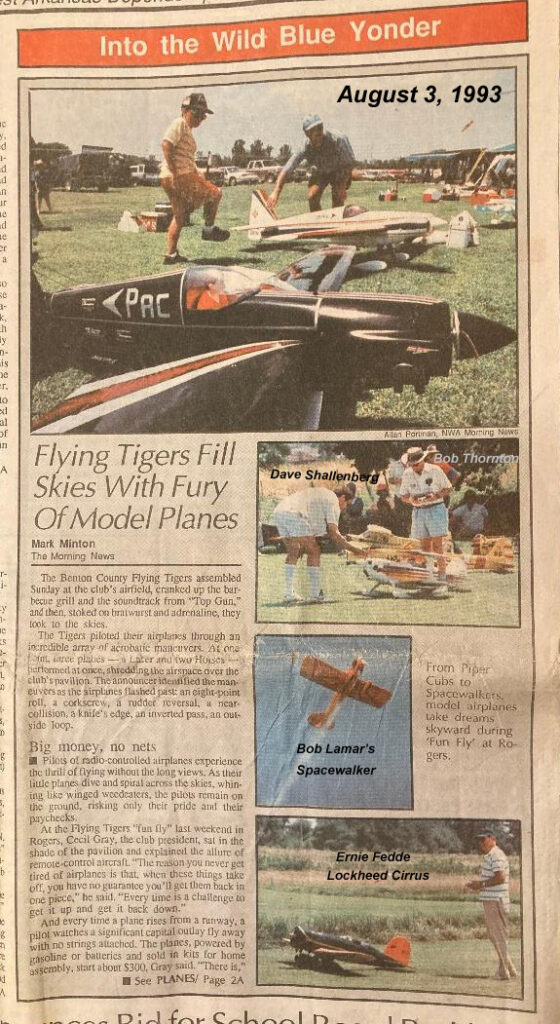
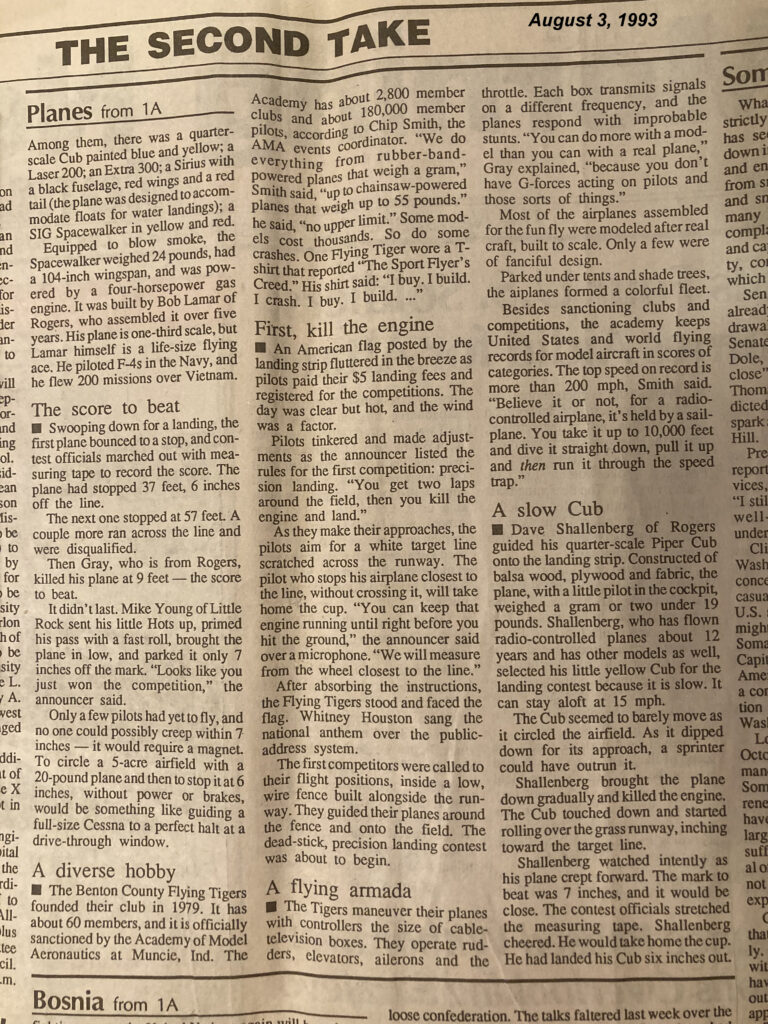
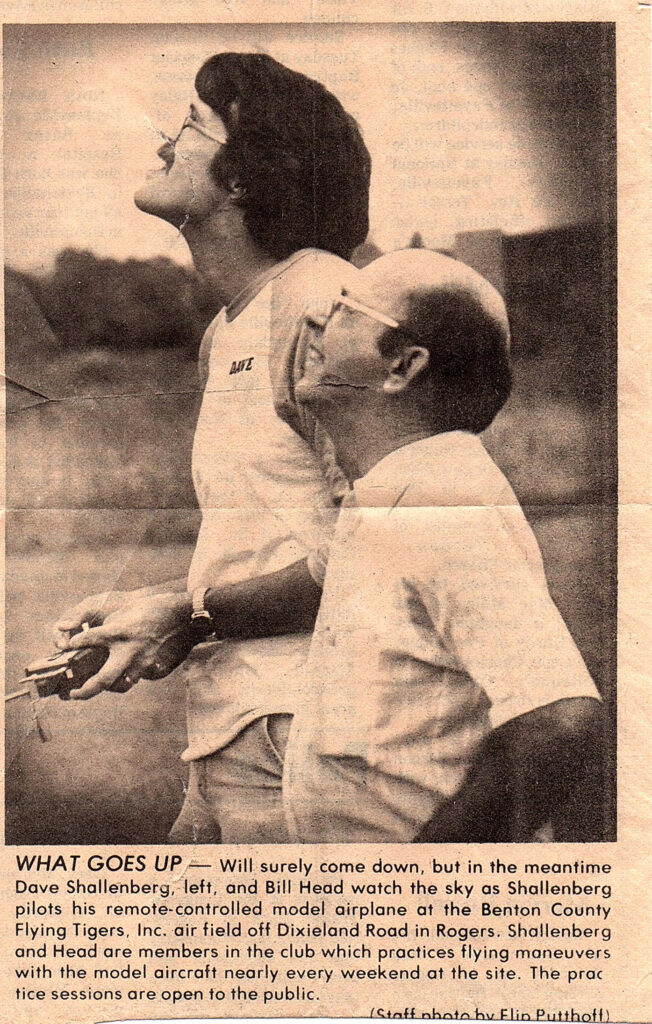
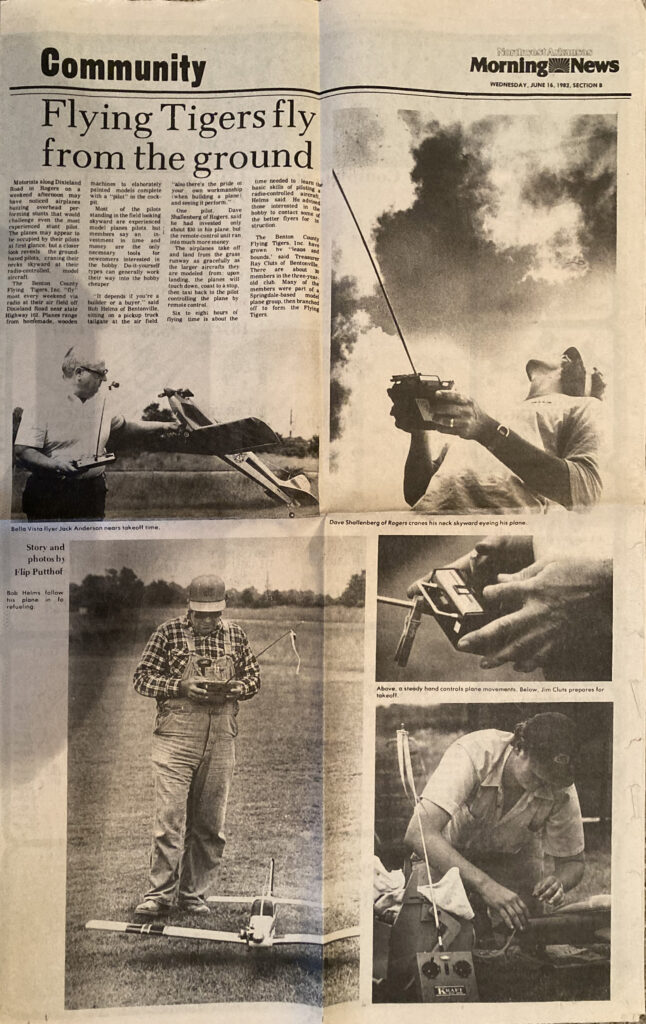
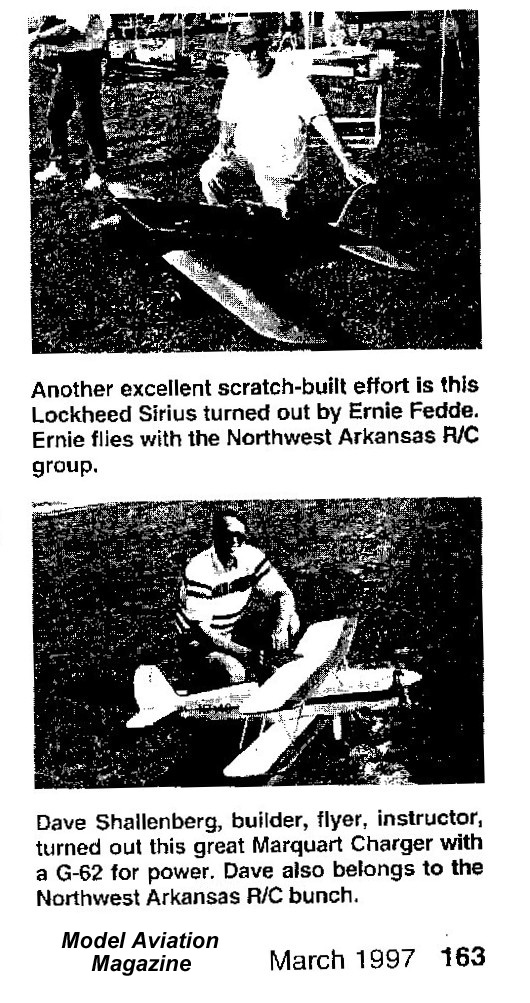
We had a good relationship with the print press early on. Attached are some of the newspaper clippings from the early days
We sponsored at least one fun fly per year starting in 1981. In the early days we would have simple competitions for small trophies or plaques. Bomb drop, Loops and Rolls, Spot Landings, Touch and Goes, Timed Landings, (contestant drew a time and would have to touch down as close to that time as possible.) We even had the contestant hand his transmitter to a person that had never flown before and timed how long it took for them to take the transmitter back.
We held a balloon busting contest at one event. The breeze was brisk enough to blow the balloons away too fast so we tethered a balloon with fine thread. It was insane how aggressively six guys would fight to win a club hat. We never had a mid air but there were several really close calls.
We had a two day fun fly in the late 1980’s. Leonard McCandliss and the Arkansas Falling Stars did parachute jumps on both days. There were attendees from as far away as Tulsa and Joplin there both days. The turn out of the community was tremendous.
The following served in the capacity of president of the BCFT:
Ron Connor, David Shallenberg, Cecil Gray, Al MacKenzi, Denny Elder, Bill Thompson, Mark Thurman.
The club was asked to fly during Aviation Days at the Rogers airport in the mid 80’s. Plane rides were being offered and the organizers wanted some aviation related activity to keep the people interested while they waited for their ride. A big group of us flew off of the taxiway with an airplane in the air most of the afternoon. I had just completed a Byron Originals F-16 ducted fan airplane and flew it several times that afternoon.
It was after that event that I was asked to speak to the morning and noon Rotary Club, Lions Club, Kiwanis Club, Optimists Club and the Odd Fellows Club. It was really good exposure for the club because it got us in front of many of the business and community government individuals in the area.
Advancements in technology have made significant changes to the sport of model aviation. Computer radios, LiPo batteries, BNF / RTF aircraft and flight simulators for personal computers have brought many more people into the hobby quickly and inexpensively. Kits and materials for building planes are getting scarce which is sad. Kit building or plans building bring another dimension to the hobby. There is a great deal of satisfaction in seeing your creation take to the sky.
I would encourage anyone who is interested in building a plane to “ask an old guy”. There is likely many years of experience and many models built that have revealed stumbling blocks and shortcuts to success.
Benton County Flying Tigers News Articles

Thank You!
On behalf of the Benton County Flying Tigers, we extend our heartfelt thanks to David Shallenberg for compiling the club’s history and to Bill Murphy for sharing the unforgettable story of Bob Thornton crashing through the roof of the Clorox plant. Your contributions help preserve the character, humor, and heritage of our club, giving both current members and future generations a vivid connection to our past. We truly appreciate the time, effort, and storytelling you’ve shared with us.